
Chest Workout at Home: Complete Beginner Guide to Building a Stronger Chest
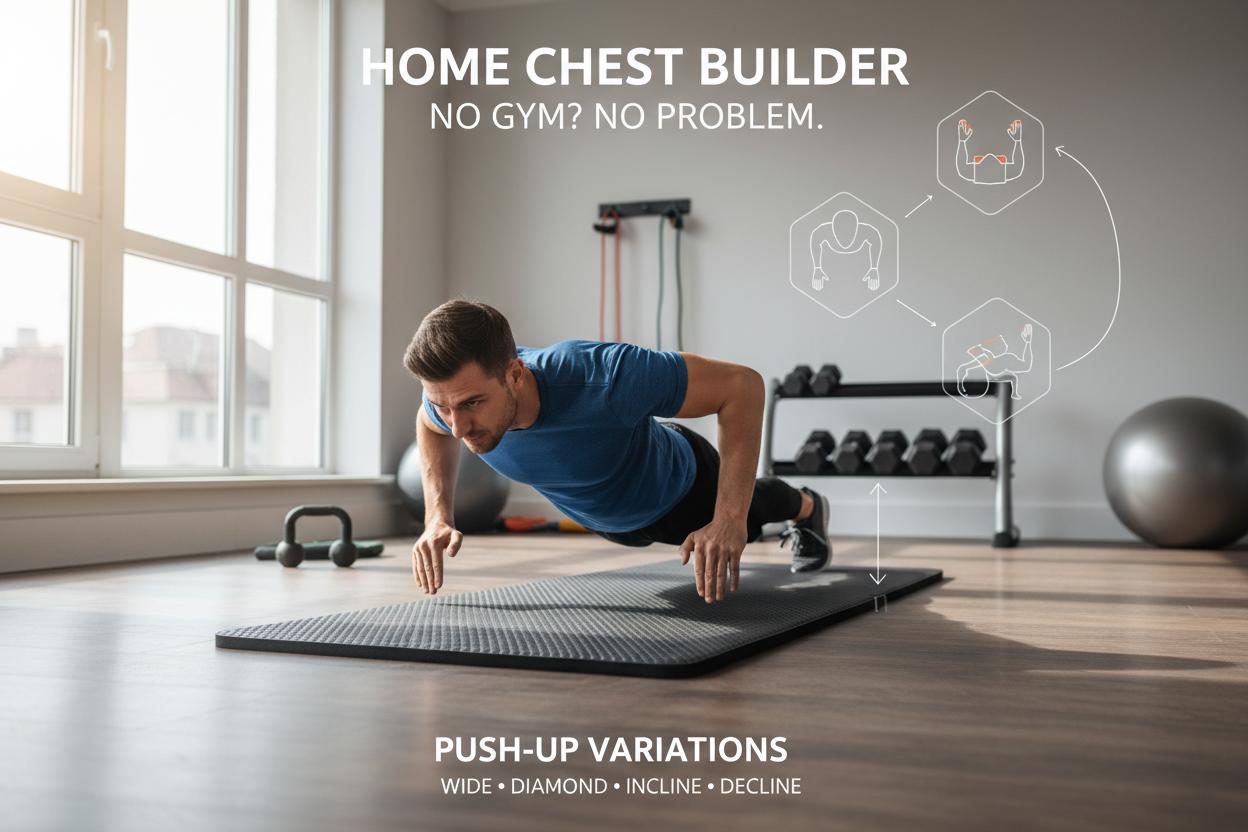
Want to build a stronger and more muscular chest without going to the gym? Good news: you can start with a chest workout at home using nothing more than your body weight and a small amount of floor space.
You do not need a bench press, expensive machines, or a complicated home gym to begin. Exercises such as push-ups and their easier or harder variations can provide an effective starting point, while dumbbells can give you more options as you become stronger.
But there is one important thing beginners often miss: doing more exercises does not automatically mean getting better results.
Your goal should be to learn proper technique, choose an appropriate difficulty level, train consistently, and gradually make the workout more challenging.
This guide will show you exactly how to start a chest workout at home, whether you have no equipment, a pair of dumbbells, or only a few minutes available.
What Is a Chest Workout at Home?
A chest workout at home is a series of exercises performed at home to strengthen and develop the muscles of your chest, mainly the pectoralis major and pectoralis minor.
The simplest option is bodyweight training. Push-ups are especially useful because they train the chest while also involving the triceps, shoulders and core.
You can also use dumbbells, resistance bands, or other suitable equipment to increase resistance as your strength improves. Home training can therefore range from completely equipment-free workouts to more advanced routines using dumbbells.
The biggest advantage is convenience. You can train in your bedroom, living room, terrace, or another safe area without spending time travelling to a gym.
More importantly, home training can work when it is structured around progressive overload—gradually increasing the challenge over time rather than repeating exactly the same workout forever.
Can You Build Your Chest With a Chest Workout at Home?
Yes.
You can improve chest strength and build muscle at home, especially if you are a beginner. Bodyweight exercises can provide enough resistance to create a training stimulus, while variations such as incline, standard, decline and diamond push-ups allow you to adjust difficulty.
However, there is an important distinction between starting at home and training forever without increasing difficulty.
If your current push-up variation becomes very easy, performing hundreds of identical repetitions may not be the most efficient way to continue progressing.
Instead, you can:
- Increase repetitions gradually
- Add another set
- Slow down the lowering phase
- Move to a harder push-up variation
- Add resistance with a backpack or resistance band
- Use dumbbells
- Improve your range of motion
- Reduce assistance from an easier variation
This concept is called progressive overload.
Think of it this way:
Beginner → stronger → harder exercise → stronger again.
That simple cycle is what makes your home workout continue to challenge you.
Chest Muscles You Should Understand as a Beginner
You don’t need to memorize complicated anatomy before starting your workout.
Just understand that the chest is primarily made up of:
Pectoralis Major
This is the large, visible muscle covering much of the front of your chest. It is responsible for several pushing and arm movements.
Pectoralis Minor
This is a smaller muscle underneath the pectoralis major. It contributes to movement and stability around the shoulder blade.
Different pressing and push-up angles can change which parts of the chest and surrounding muscles receive more emphasis. But don’t get trapped thinking that you need a separate exercise for every tiny section of your chest.
For beginners, getting stronger at basic pressing movements is far more important than chasing dozens of exercises.
7 Best Chest Exercises at Home for Beginners
Instead of randomly selecting exercises from social media, start with a small group that you can actually perform correctly.
1. Wall Push-Ups
If you cannot perform a regular push-up yet, start here.
Stand facing a wall and place your hands against it around chest height. Keep your body relatively straight, bend your elbows and bring your chest toward the wall. Push yourself back to the starting position.
Beginner target: 2–3 sets of 10–15 reps
Best for: Complete beginners
Wall push-ups reduce the amount of body weight you have to move, making them an excellent starting point for developing pushing strength.
2. Incline Push-Ups
Once wall push-ups become easy, move to incline push-ups.
Place your hands on a stable elevated surface such as a sturdy table or countertop. Walk your feet back, keep your body straight and lower your chest toward the surface.
Beginner target: 3 sets of 8–12 reps
Important: Make sure the surface is stable before exercising.
Incline push-ups are easier than floor push-ups and can help you gradually work toward the standard version.
3. Standard Push-Ups
The classic push-up should be the foundation of your chest workout at home.
Place your hands approximately shoulder-width apart or slightly wider. Extend your legs behind you and create a straight line from your head through your hips to your feet.
Lower your body under control, then push through your hands to return to the starting position.
Beginner target: 3 sets of 5–12 reps
Don’t worry if you can only perform a few clean repetitions initially.
Five controlled repetitions are more valuable than fifteen rushed repetitions with poor technique.
4. Knee Push-Ups
Knee push-ups can be used as a progression or regression depending on your current strength.
Place your knees on the floor, keep your upper body controlled and perform the push-up while maintaining a stable torso.
Beginner target: 3 sets of 8–15 reps
If regular push-ups are currently too difficult, knee push-ups can help you practice the movement pattern while developing strength.
5. Wide Push-Ups
For wide push-ups, place your hands somewhat wider than your normal push-up position.
Lower your body under control and push back up.
Target: 2–3 sets of 8–12 reps
Don’t exaggerate the width of your hands. Extremely wide positioning isn’t necessary to make the exercise effective.
Focus on controlled movement rather than trying to make the exercise look impressive.
6. Decline Push-Ups
Once standard push-ups become comfortable, you can increase the difficulty by placing your feet on a stable elevated surface.
This changes the angle of the movement and makes the exercise more challenging.
Target: 2–3 sets of 6–12 reps
Decline push-ups are better suited to people who already have a reasonable level of push-up strength.
7. Diamond Push-Ups
Bring your hands closer together underneath your chest and form a diamond-like shape with your fingers.
Lower yourself slowly and push back up.
Target: 2–3 sets of 5–10 reps
Diamond push-ups are challenging and involve the triceps heavily, so beginners shouldn’t feel pressured to use them immediately.
Master regular push-ups first.
For more info visit Youtube
Chest Workout at Home With Dumbbells
If you own dumbbells, you have another useful option for increasing resistance.
A chest workout at home with dumbbells doesn’t necessarily require a bench. Floor-based dumbbell exercises can be performed with appropriate weights, and several home routines use dumbbells without requiring a traditional gym bench.
1. Dumbbell Floor Press
Lie on your back with a dumbbell in each hand.
Bend your knees and keep your feet on the floor. Start with the dumbbells around chest level. Press them upward, then lower them under control until your upper arms gently contact the floor.
Beginner target: 3 sets of 8–12 reps
The floor naturally limits how far your elbows can travel, which can make this a practical home pressing movement.
2. Dumbbell Crush Press
Lie on the floor and hold two dumbbells close together above your chest.
Press the dumbbells upward while maintaining pressure between them, then lower them slowly.
Target: 2–3 sets of 10–15 reps
Use a manageable weight and focus on controlled movement.
3. Dumbbell Floor Fly
Lie on your back with dumbbells above your chest and your palms facing each other.
With a slight bend in your elbows, lower your arms outward in a controlled manner, then bring the dumbbells back together.
Target: 2 sets of 8–12 reps
Because fly movements can place more demand on the shoulder when performed poorly, beginners should use light weights and prioritize control.
If you’re completely new to resistance training, mastering pressing movements first is a sensible approach.
Beginner Chest Workout at Home: 20-Minute Routine
If you don’t know where to start, don’t overcomplicate it.
Try this simple routine.
| Exercise | Sets | Reps |
|---|---|---|
| Incline or Knee Push-Ups | 3 | 8–12 |
| Standard Push-Ups | 3 | 5–12 |
| Wide Push-Ups | 2 | 8–12 |
| Slow Push-Ups | 2 | 5–10 |
| Plank | 2 | 20–30 sec |
Rest approximately 60–90 seconds between sets.
If standard push-ups are currently impossible, replace them with incline or knee push-ups.
Your workout should match your current ability—not someone else’s Instagram workout.
5-Minute Warm-Up Before Your Chest Workout at Home
Don’t jump straight into hard push-ups when your body is cold.
A short warm-up can prepare you for the session.
Try:
- Arm circles — 30 seconds
- Shoulder rolls — 30 seconds
- Wall push-ups — 10 reps
- Easy incline push-ups — 8 reps
- Arm swings — 30 seconds
- Light plank hold — 20 seconds
The purpose isn’t to exhaust yourself.
You simply want to gradually prepare your shoulders, arms and upper body for the workout.
Warm-ups are commonly included in home chest routines because they help transition the body into training.
How Many Days a Week Should You Do a Chest Workout at Home?
Beginners don’t need to train their chest every day.
Start with 2–3 chest-focused sessions per week, depending on your overall training schedule and recovery.
For example:
Monday: Chest workout
Tuesday: Rest or lower body
Wednesday: Rest
Thursday: Chest workout
Friday: Rest
Saturday: Optional full-body workout
Sunday: Rest
Give your muscles time to recover between hard sessions.
Remember: your workout provides the stimulus, but recovery is part of the process too.
How to Progress Your Chest Workout at Home
This is where many beginners go wrong.
They perform the same 10 push-ups every day for months and wonder why progress slows down.
Instead, use a simple progression system.
Week 1
3 sets of 6 push-ups
Week 2
3 sets of 8 push-ups
Week 3
3 sets of 10 push-ups
Week 4
3 sets of 12 push-ups
Once you can comfortably perform the upper end of your target range with good technique, make the movement harder.
For example:
Incline push-up → knee push-up → standard push-up → decline push-up
You can also increase difficulty by slowing your repetitions or adding resistance.
Progressive overload can involve increasing repetitions, sets, resistance or exercise difficulty.
Common Chest Workout at Home Mistakes Beginners Should Avoid
1. Doing Push-Ups Every Day
More training isn’t automatically better.
Your muscles need recovery, especially when you’re performing challenging sets.
2. Using Bad Form
Don’t let your hips collapse or your lower back excessively arch.
Keep your body controlled throughout the movement.
3. Doing Repetitions Too Quickly
Fast repetitions can turn your workout into a race.
Instead, lower your body under control and push back up with purpose.
4. Starting With Advanced Exercises
You don’t need archer push-ups or extremely difficult variations on day one.
Build your foundation first.
5. Chasing Chest Burn Instead of Progress
A huge pump or burning sensation isn’t the only indicator of an effective workout.
Track your actual performance.
Can you perform more clean repetitions?
Can you use a harder variation?
Can you control the movement better?
Those are much more useful measures of progress.
6. Ignoring the Rest of Your Body
A strong chest is great, but don’t train only your chest.
Include back, legs, shoulders, arms and core work in your overall routine to create a balanced fitness program.
Can You Lose Chest Fat With a Chest Workout at Home?
This is one of the biggest questions beginners have.
A chest exercise can strengthen the muscles underneath the area, but you cannot reliably choose exactly where your body loses fat.
If your goal is to reduce overall body fat, focus on your complete lifestyle: regular physical activity, resistance training, adequate nutrition, sleep and an appropriate calorie intake.
So don’t fall for claims that one particular chest exercise will magically burn fat specifically from your chest.
Build the muscle and work toward healthy overall body composition instead.
How Long Does It Take to See Results From a Chest Workout at Home?
There is no single timeline that applies to everyone.
Your results depend on factors such as:
- Starting fitness level
- Training consistency
- Exercise selection
- Progressive overload
- Nutrition
- Sleep
- Genetics
- Overall body composition
A beginner may notice improvements in strength relatively quickly, while visible changes in muscle size can take longer.
Don’t judge your progress after three or four workouts.
Give your routine enough time to work.
Instead of checking the mirror every day, track your push-up repetitions, exercise variations and overall strength.
Chest Workout at Home: Beginner Progression Guide
Here’s a simple roadmap you can follow.
Level 1 — Complete Beginner
Start with:
- Wall push-ups
- Incline push-ups
- Knee push-ups
Your goal is to learn control and build basic pushing strength.
Level 2 — Beginner
Move toward:
- Standard push-ups
- Wide push-ups
- Slow push-ups
Aim to gradually increase repetitions while maintaining good form.
Level 3 — Intermediate
Try:
- Decline push-ups
- Diamond push-ups
- Tempo push-ups
- Dumbbell floor press
At this point, your workout can become more challenging.
Level 4 — Advanced
You can experiment with:
- Archer push-ups
- Weighted push-ups
- More difficult unilateral variations
- Heavier dumbbell pressing
Don’t rush toward Level 4.
The goal isn’t to perform the hardest exercise possible. The goal is to become stronger over time.
Chest Workout at Home Without Equipment vs With Dumbbells
Which option is better?
Both can work.
Without equipment:
Best if you’re starting from zero, have limited space, or want maximum simplicity.
With dumbbells:
Better if you want an easy way to add external resistance and continue progressing after basic bodyweight movements become easier.
A pair of dumbbells can also make exercises such as floor presses practical when you don’t have access to a bench.
If you’re a complete beginner, don’t feel that you need to buy equipment immediately.
Start with your body weight.
Add equipment when your current training becomes limiting.
Frequently Asked Questions About Chest Workout at Home
Can I build a bigger chest at home?
Yes. Beginners can build chest strength and muscle at home using bodyweight exercises and progressive overload. Adding resistance through dumbbells or other equipment can provide more progression options as you become stronger.
Is 20 minutes enough for a chest workout at home?
Yes. A 20-minute session can be useful if it contains challenging exercises and you train consistently. Workout duration is less important than exercise quality, progression and consistency.
How many push-ups should a beginner do?
There is no universal number. Start with a variation that allows you to perform controlled repetitions. For many beginners, 5–12 quality repetitions per set is a practical starting range.
Can I do a chest workout at home without dumbbells?
Absolutely. Push-up variations can provide a complete starting point for chest training without equipment.
Should beginners do chest workouts every day?
Usually, no. Give your muscles adequate recovery between challenging chest sessions. Two or three focused sessions per week can be enough for many beginners.
Is chest workout at home good for women?
Yes. Chest exercises are not exclusively for men. Women can use the same basic movements and simply adjust the exercise difficulty and resistance according to their strength level.
Do I need a bench for a chest workout at home with dumbbells?
No. Exercises such as dumbbell floor presses can be performed without a traditional bench.
What is the best chest exercise for beginners?
There isn’t one exercise that is best for everyone. Incline push-ups are an excellent starting point for people who cannot yet perform standard push-ups, while standard push-ups can become the foundation of a beginner’s home chest routine.
Final Takeaway
A good chest workout at home doesn’t need to be complicated.
If you’re a beginner, start with an exercise you can perform correctly. Master the movement, gradually increase your repetitions, and then progress to a harder variation.
Your basic roadmap can be:
Wall push-ups → Incline push-ups → Knee push-ups → Standard push-ups → Harder variations → Added resistance
If you have dumbbells, you can also add movements such as the dumbbell floor press to increase your training options.
Most importantly, don’t expect a dramatic transformation after a few workouts.
Train consistently, recover properly, eat well and progressively challenge your muscles.
You don’t need a perfect home gym.
You need a routine you can actually stick with.
Start where you are. Get stronger. Then make the workout harder.
That is the foundation of an effective chest workout at home. for more info visit