
Upper Body Workout for Beginners: Complete Guide to Building Strength at Home or Gym
Starting a fitness journey can feel confusing. You may know that you want stronger arms, a bigger chest, wider shoulders, or a stronger back—but you may not know which exercises to do, how many sets and reps to perform, or whether you even need a gym.
The good news is that you don’t need a complicated routine to begin.
A well-planned upper body workout can train your chest, back, shoulders, biceps, triceps, and supporting muscles using simple movements. You can perform many of these exercises at a gym, while an upper body workout at home can be built around bodyweight exercises, dumbbells, resistance bands, or even simple household alternatives when appropriate.
This guide is designed specifically for beginners. Instead of throwing dozens of exercises at you, we’ll explain what to do, why you’re doing it, how to progress, and how to avoid common mistakes.
What Is an Upper Body Workout?
An upper body workout is a training session focused mainly on the muscles above your waist.
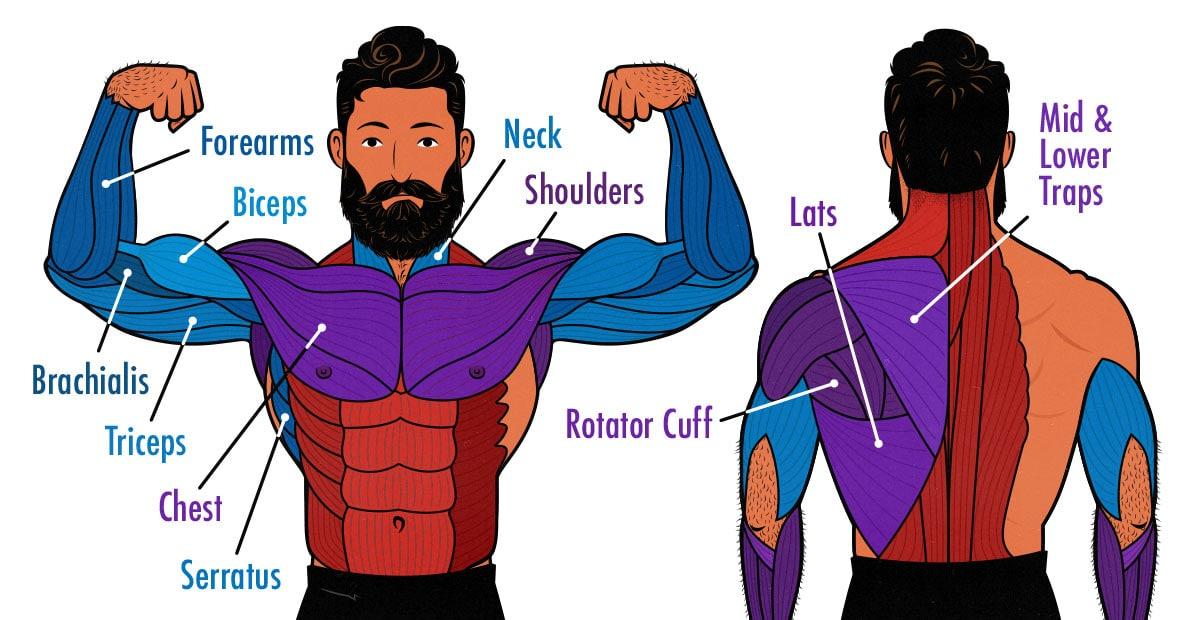
The major muscle groups include:
- Chest: Mainly the pectoral muscles, which help with pushing movements.
- Back: Includes muscles such as the lats, traps, and rhomboids, which are important for pulling and posture.
- Shoulders: The deltoids help with lifting and moving your arms.
- Biceps: Located at the front of your upper arm and involved in pulling and curling movements.
- Triceps: Located at the back of your upper arm and important for pushing and extending the elbow.
- Core: Although the core isn’t strictly an upper-body muscle group, it often works during upper-body exercises to stabilize your body.
A good upper body workout should not focus only on the muscles you can see in the mirror. Training both pushing and pulling movements creates a more balanced routine.
For example, combining push-ups with rows is generally more balanced than doing several different types of pressing exercises and ignoring your back.
ACE’s exercise library similarly organizes exercises by areas such as the chest, back, arms, and shoulders and includes beginner movements that require little or no equipment.
Why Should Beginners Do an Upper Body Workout?
A consistent upper body workout can help you develop strength that is useful both inside and outside the gym.
Upper-body strength can make everyday activities such as carrying bags, lifting objects, pushing doors, and moving furniture easier.
Resistance training is also useful for improving physical fitness and maintaining functional strength over time. ACE recommends beginners start with manageable resistance-training routines rather than immediately jumping into advanced programs.
Here are some potential benefits:
1. Builds Upper-Body Strength
Regular resistance training gives your muscles a reason to adapt and become stronger.
2. Helps Build Muscle
When training is combined with adequate nutrition, recovery, and progressive overload, an upper body workout can contribute to muscle growth.
3. Improves Muscular Balance
Training your chest, back, shoulders, and arms instead of concentrating on only one area creates a more complete routine.
4. Supports Everyday Movement
Strong upper-body muscles can help with practical movements such as carrying, pulling, pushing, and lifting.
5. Can Be Done Almost Anywhere
You don’t necessarily need a fully equipped gym. A well-designed upper body workout at home can use push-ups, rows with resistance bands, dumbbells, and other simple movements.
Upper Body Muscles You Should Train
Before choosing exercises, understand what you’re actually training.
Chest
The chest is heavily involved in pushing movements.
Good beginner choices include:
- Push-ups
- Incline push-ups
- Dumbbell chest press
- Dumbbell floor press
Back
Your back needs pulling exercises. This is one area beginners sometimes neglect because it is harder to see while training.
Useful exercises include:
- Resistance-band rows
- One-arm dumbbell rows
- Dumbbell rows
- Assisted pull-ups
- Lat pulldowns
Shoulders
The shoulders help move your arms in different directions.
Beginner exercises include:
- Dumbbell shoulder press
- Lateral raises
- Front raises
- Rear-delt flyes
Biceps
The biceps assist with pulling and elbow-flexion movements.
Common exercises include:
- Dumbbell curls
- Hammer curls
- Resistance-band curls
Triceps
The triceps are important for pushing movements and make up a large portion of the upper arm.
Beginner options include:
- Overhead triceps extensions
- Triceps kickbacks
- Close-grip push-ups
- Resistance-band pressdowns
A balanced upper body workout should give attention to all these areas instead of spending the entire session on arms.
8 Best Upper Body Workout Exercises for Beginners
You don’t need 20 exercises in one session. A few well-selected movements can cover most of your major upper-body muscles.
1. Push-Ups
Push-ups are one of the simplest exercises for a beginner upper body workout.
They primarily train the chest while also involving the triceps and shoulders.
How to perform:
- Place your hands slightly wider than shoulder-width apart.
- Keep your body relatively straight.
- Brace your core.
- Lower your chest under control.
- Push the floor away and return to the starting position.
If regular push-ups are too difficult, start with wall push-ups or incline push-ups.
ACE classifies the bent-knee push-up as a beginner exercise and identifies the chest, arms, and shoulders as the main areas involved.
Beginner target: 2–3 sets of 6–12 reps.
2. One-Arm Dumbbell Row
A row gives your upper body workout a pulling movement to balance pressing exercises.
It mainly trains the back while also involving the arms and shoulders.
How to perform:
- Place one hand on a stable bench or surface.
- Hold the dumbbell with your opposite hand.
- Keep your back in a comfortable neutral position.
- Pull the dumbbell toward your hip.
- Lower it slowly.
Don’t turn the exercise into a twisting movement. Think about pulling your elbow backward rather than simply moving the weight upward.
Beginner target: 2–3 sets of 8–12 reps per side.
3. Dumbbell Shoulder Press
The shoulder press is a useful vertical pushing movement.
It primarily targets the shoulders while also involving the triceps.
How to perform:
- Hold a dumbbell in each hand.
- Start with the weights around shoulder height.
- Keep your core controlled.
- Press the dumbbells overhead.
- Lower them slowly.
Start light. Overhead movements are not the place to sacrifice technique just to lift heavier weights.
Beginner target: 2–3 sets of 8–12 reps.
4. Dumbbell Biceps Curl
The biceps curl is simple and easy to understand, making it useful near the end of a beginner upper body workout.
How to perform:
- Stand tall with a dumbbell in each hand.
- Keep your elbows close to your body.
- Curl the weights upward.
- Squeeze your biceps gently.
- Lower the dumbbells under control.
Avoid swinging your body to move the weight.
Beginner target: 2 sets of 10–15 reps.
5. Overhead Triceps Extension
This exercise directly trains the triceps.
You can perform it with one dumbbell or a resistance band.
How to perform:
- Hold one dumbbell above your head.
- Keep your elbows pointing mostly forward.
- Lower the weight behind your head.
- Extend your elbows to bring it back up.
- Repeat with controlled movement.
Choose a manageable weight because maintaining elbow control is more important than lifting heavy.
Beginner target: 2 sets of 10–15 reps.
6. Lateral Raise
Lateral raises are commonly used to train the side portion of the shoulders.
How to perform:
- Stand with light dumbbells beside your body.
- Keep a slight bend in your elbows.
- Raise your arms outward.
- Stop around shoulder height or within a comfortable range.
- Lower slowly.
Use light weights. Beginners often make the mistake of choosing dumbbells that are far too heavy for this movement.
Beginner target: 2 sets of 10–15 reps.
7. Resistance-Band Row
If you’re doing an upper body workout at home, resistance bands can make pulling exercises much easier to include.
Anchor the band securely, maintain good posture, and pull the handles or band toward your torso.
The biggest advantage is that you can train your back without needing a large machine.
Beginner target: 2–3 sets of 10–15 reps.
8. Plank
The plank isn’t a traditional upper-body isolation exercise, but your shoulders, arms, and core work together to maintain your position.
It can be useful as a finishing exercise for a beginner routine.
Beginner target: 2–3 sets of 15–30 seconds.
Focus on maintaining good alignment rather than holding the plank for several minutes.
Beginner Upper Body Workout Routine
Now let’s put everything together.
If you’re new to strength training, you don’t need a huge workout.
Simple Beginner Upper Body Workout
| Exercise | Sets | Reps |
|---|---|---|
| Push-ups | 3 | 6–12 |
| One-arm dumbbell row | 3 | 8–12 |
| Dumbbell shoulder press | 2 | 8–12 |
| Dumbbell biceps curl | 2 | 10–15 |
| Overhead triceps extension | 2 | 10–15 |
| Lateral raise | 2 | 10–15 |
| Plank | 2 | 15–30 sec |
Rest roughly 60–120 seconds between sets, adjusting the rest period based on your fitness level and the exercise.
The goal isn’t to finish as quickly as possible. The goal is to perform controlled repetitions with good technique.
Upper Body Workout at Home: No Gym Required
You can create an effective upper body workout at home without owning a complete home gym.
A simple home setup can include:
- Your bodyweight
- A pair of dumbbells
- Resistance bands
- A sturdy exercise surface
- A pull-up bar if available
For example, your home routine could look like this:
Upper Body Workout at Home
Push-ups: 3 × 6–15
Resistance-band rows: 3 × 10–15
Pike push-ups: 2 × 6–12
Band biceps curls: 2 × 10–15
Band triceps extensions: 2 × 10–15
Lateral raises with light dumbbells: 2 × 10–15
Plank: 2 × 20–30 seconds
If you cannot perform standard push-ups yet, use an incline surface or wall.
The same principle applies to pulling movements: choose a variation that allows you to maintain control.
ACE’s beginner exercise resources include numerous no-equipment exercises, while its resistance-training guidance also provides examples of home-based routines.
Also, watchout Youtube
How Many Days a Week Should You Do an Upper Body Workout?
Beginners don’t need to train their upper body every day.
A practical starting point is 2 upper-body-focused sessions per week, with enough recovery between demanding sessions.
For example:
Monday: Upper body
Tuesday: Rest or light activity
Wednesday: Lower body
Thursday: Rest
Friday: Upper body
Saturday: Light activity
Sunday: Rest
Your exact schedule can change depending on your overall fitness program.
The important point is to give trained muscles time to recover.
ACE notes that beginners can perform resistance-training workouts on non-consecutive days and build their routine progressively.
How Many Reps Should Beginners Do?
There isn’t one magical number of repetitions that works for everyone.
For most beginner exercises, a practical starting range is:
- Strength-focused movements: around 6–12 reps
- Isolation exercises: around 10–15 reps
- Core holds: around 15–30 seconds
The final repetitions should feel challenging while still allowing you to maintain good technique.
Don’t force a repetition if your form has completely broken down.
Learning movement quality first is particularly important for beginners. ACE also emphasizes establishing mobility and stability before progressing to more complex movements and heavier loads.
How to Progress Your Upper Body Workout
Doing exactly the same workout with exactly the same resistance forever will eventually become less challenging.
This is where progressive overload comes in.
You can gradually progress by:
- Adding a few repetitions.
- Increasing the weight slightly.
- Adding another set.
- Using a more difficult exercise variation.
- Improving your technique and range of motion.
- Reducing unnecessary momentum.
For example, suppose you start dumbbell curls with 5 kg and perform 10 controlled repetitions.
After several weeks, you may be able to perform 15 controlled repetitions.
Instead of immediately making a huge jump in weight, you could gradually increase the resistance and return to a lower repetition range.
Progress doesn’t have to mean lifting dramatically heavier weights every week.
Common Upper Body Workout Mistakes Beginners Make
1. Training Only the Chest and Arms
A common beginner mistake is focusing on muscles that are easy to see in the mirror.
Don’t forget your back and shoulders.
2. Using Too Much Weight
Heavy weights don’t automatically produce better results.
If you have to swing, twist, or lose control to complete the repetition, the weight may be too heavy.
3. Doing Too Many Exercises
More exercises don’t necessarily mean better results.
A simple routine performed consistently is often easier for a beginner to recover from and stick with.
4. Ignoring Pulling Movements
Push-ups and presses are useful, but your upper body workout should also include pulling exercises such as rows.
5. Skipping Warm-Up
Spend a few minutes preparing your body before training.
Light movement, controlled arm movements, and easier versions of your first exercise can help you transition into the session.
6. Training Through Sharp Pain
Muscle fatigue and effort are normal. Sharp or unusual pain is different.
Stop an exercise that causes concerning pain and seek professional medical advice when appropriate.
How Long Should an Upper Body Workout Take?
You don’t need to spend two hours in the gym.
For most beginners, approximately 30–60 minutes is enough for a focused upper body workout, depending on the number of exercises, sets, rest periods, and your experience level.
A simple structure could be:
5–10 minutes: Warm-up
25–40 minutes: Main workout
5 minutes: Easy cooldown or mobility work
The quality of your training matters more than simply staying in the gym for a long time.
Can You Build Muscle With an Upper Body Workout at Home?
Yes, you can make progress with an upper body workout at home.
The challenge is not whether you are inside a gym. The challenge is whether your muscles receive enough training stimulus and whether you progressively make the workout more difficult.
Bodyweight exercises can become harder through exercise variations, additional repetitions, slower controlled movements, and greater range of motion.
Dumbbells and resistance bands give you even more options.
For example:
Beginner: Wall push-up
↓
Intermediate: Incline push-up
↓
Advanced: Standard push-up
↓
More challenging: Feet-elevated or weighted variation
This progression allows a home routine to evolve as your strength improves.
What Should You Eat for an Upper Body Workout?
Exercise is only one part of building a stronger body.
Your overall diet should provide enough:
- Protein
- Carbohydrates
- Healthy fats
- Vitamins and minerals
- Fluids
Protein is particularly important for supporting muscle repair and growth, while carbohydrates can provide energy for training.
You don’t need expensive supplements to start exercising.
Foods such as eggs, milk, curd, paneer, dal, beans, chickpeas, soy products, chicken, fish, nuts, and seeds can all contribute to a balanced diet.
Your exact nutrition needs depend on factors such as your body size, activity level, goals, and total calorie intake.
Upper Body Workout: Beginner FAQ
Is an upper body workout good for beginners?
Yes. Beginners can start with simple movements such as push-ups, rows, shoulder presses, curls, and triceps exercises. Start with manageable resistance and prioritize technique.
Can I do an upper body workout at home?
Absolutely. An upper body workout at home can use bodyweight exercises, resistance bands, or dumbbells. You don’t need a commercial gym to begin building strength.
How often should beginners do an upper body workout?
Two sessions per week is a reasonable starting point for many beginners, provided you allow adequate recovery and consider your complete training schedule.
Can I build bigger arms with an upper body workout?
Yes, training the biceps and triceps can contribute to arm muscle growth. However, muscle growth also depends on progressive training, nutrition, recovery, and individual factors.
Should I do cardio before an upper body workout?
If strength and muscle development are your main goals, keep intense cardio before your strength session limited. A short, easy warm-up is usually enough to prepare you for training.
Do I need dumbbells for an upper body workout?
No. You can begin with bodyweight movements such as push-ups and some resistance-band exercises. Dumbbells simply provide additional ways to progressively increase resistance.
How quickly will I see results?
Results vary from person to person. Beginners may notice improvements in exercise performance and strength before seeing major visual changes. Consistency over weeks and months is more important than looking for overnight results.
Your Simple Upper Body Workout Plan
If you’re completely new, don’t overcomplicate your first month.
Start with:
2 days per week
Workout A
- Push-ups — 3 × 6–12
- Dumbbell rows — 3 × 8–12
- Shoulder press — 2 × 8–12
- Biceps curls — 2 × 10–15
- Triceps extensions — 2 × 10–15
- Plank — 2 × 20–30 seconds
Workout B
- Incline push-ups — 3 × 8–15
- Resistance-band rows — 3 × 10–15
- Lateral raises — 2 × 10–15
- Hammer curls — 2 × 10–15
- Triceps kickbacks — 2 × 10–15
- Plank — 2 × 20–30 seconds
Leave at least a day between demanding upper-body sessions.
As you become stronger, gradually increase repetitions, resistance, or exercise difficulty.
Final Thoughts
Starting an upper body workout doesn’t need to be complicated.
You don’t need an expensive gym membership, advanced exercises, or a huge collection of equipment. What you need is a simple routine that trains the major upper-body muscle groups, good technique, enough recovery, and the patience to progress over time.
If you’re training at home, an upper body workout at home can be just as convenient and beginner-friendly. Start with exercises you can perform safely, master the movement, and gradually make your training more challenging.
Most importantly, don’t judge your progress after only a few workouts.
Your first goal is to build the habit.
Your second goal is to improve your technique.
Your third goal is to gradually become stronger.
Do those three things consistently, and your upper body workout can become a solid foundation for your long-term fitness journey.
For more info visit